Produit scalaire et calcul vectoriel avec trois points
Exercice corrigé - Spécialité maths, première générale
Énoncé
A, B et C sont trois points tels que AB=5 et AC=8 et 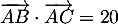 .
.
- Aurait-il été possible d'avoir
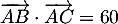 ?
- Quel est la valeur de l'angle
 ?
- Calculer le produit scalaire
 .
- Calculer
 .
Correction
Correction
A, B et C sont trois points tels que AB=5 et AC=8.- On a le produit scalaire
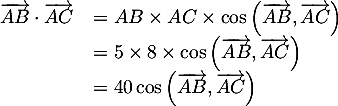
et donc, pour avoir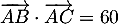 , on devrait avoir

ce qui n'aurait donc pas été possible car, pour tout angle , on a
 .
- En utilisant le même produit scalaire que dans la question précédente, on a cette fois

d'où

On en déduit l'angle .
-
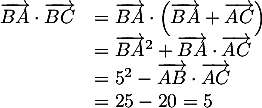
- On passe par le carré scalaire, qui permet d'utiliser la relation de Chasles:
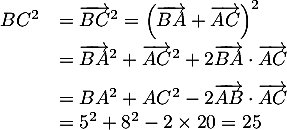
d'où on en déduit la longueur .
Tag:Produit scalaire
Autres sujets au hasard:

Voir aussi:
Quelques devoirs
produit scalaire, angles en radians (cercle trigonométrique et mesure principale) et étude de fonction
Produit scalaire et fonctions dérivées: vecteurs et coordonnées et produit scalaire, calcul vectoriel et calcul d'angle - étude du sens de variation d'une fonction
arbre de probabilités, probabilités condtionnelles, et calcul d'un angle à l'aide du produit scalaire
Géométrie avec le produit scalaire, projeté orthogonal et calcul d'un angle et droites tangentes à une parabole perpendiculaires
Géométrie avec le produit scalaire, et probabilités conditionnelles et arbres de probabilités